Common Pricing Mistakes That Kill Indie Apps
You picked a price. Probably $4.99, because that is what the other apps charge. Or $9.99, because six months of your life has to be worth more than five dollars.
I have done the second one. It is a terrible way to price and I understand completely why we all do it. Nobody ever tells you how to choose the number, so you reach for the only two inputs you have: what the neighbours charge, and how tired you are.
Neither of them knows anything useful. The user has never seen how long you spent building it. And the other app has a different audience, different features and a different promise, so their number does not transfer to yours.
There is also a good chance the number is not where your money is. For most indie apps the bigger lever is the ratio between the monthly plan and the annual one, and the packaging around both: which plans exist, who each one is for, and when the choice shows up.
So here are the mistakes I see most often, each one checked where I could against RevenueCat’s State of Subscription Apps 2026, which covers more than 115,000 apps.
You will also get three people who moved their annual share, one of them from 16% to 39%, and exactly what each of them changed. Plus one finding that cuts against all of it: higher-priced apps convert better and keep people worse.
In short
- Your development time is not a pricing input, and a competitor’s price only transfers when audience, features and positioning match.
- Higher-priced apps convert better and earn more, median day-35 download-to-paid runs 1.4%, 2.0% and 2.8% across the below-average, average and above-average price tiers, and they retain worse on annual: 23% year one against 36%.
- The lever with the most movement in it is usually not the number on the button. It is the ratio between your monthly plan and your annual one.
- Packaging beats pricing: which plans exist, who each one is for, and when the choice appears. Spotify, Kit and Centr all sell on that, not on the number.
Pricing without any data
The most common approach: “other apps charge $4.99/month, so I’ll charge $4.99/month.” Or worse: “I spent 6 months building this, so it should cost at least $9.99.”
The fix
Test two or three price points before you commit. But size the test against your own conversion rate, which is the share of users who end up buying, rather than against your patience.
The median freemium app, meaning one you can use for free and pay to unlock more, converts 2.1% of its installs to paid by day 35. The median app with a hard paywall, where nothing works until you subscribe, converts 10.7% (RevenueCat, 2026).
So do the arithmetic. At 2%, five hundred users give you roughly ten buyers per arm, which is the word for each version in a test. A gap of three or four buyers between two arms is noise, and you will read it as a result.
If your funnel is that narrow you have three options. Measure the step above the purchase, paywall view to trial start. Or run it for longer. Or accept that you are choosing a price rather than measuring one.
There is also an order to the work. Michal Parizek, pricing and growth lead at Mojo, puts price first and market by market, then the plan duration that holds value longest, then the ratio between plans, then the trial, and paywall design last. His reason is unglamorous: effort for effort, that is where he has seen the movement.
Making the free tier too generous
If users can do everything they need without paying, they won’t pay. It sounds obvious, but most indie creators err on this side because they’re afraid of losing users.
The result is thousands of happy free users and almost no revenue, and the size of that gap is measurable. Across 115,000+ apps, the median freemium app turns 2.1% of its installs into paying subscribers by day 35. The median app that puts a hard paywall in front of the product turns 10.7%, about five times as many, with year-one retention that is effectively identical, 28% against 27%.
The fix
Your free tier should deliver enough value that users want more; the “more” is what they pay for. Find the moment where free users naturally hit a wall: that is where your paywall belongs.
Alice Muir, a subscription consultant previously at Phiture, has a sharper version of this: gate the speed, not the capability. Her example is MyFitnessPal, which for years let free users log calories by hand and scan barcodes, holding recipes and deeper macro data behind the paywall.
Anyone whose goal was calories in, calories out could finish the job and never pay. Barcode scanning moved behind the paywall years later, the right call, made late, because people had already learned to expect it for free. Go and find the feature in your free tier that only saves time.
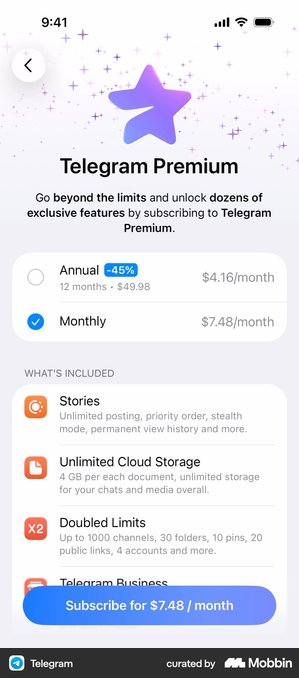
Telegram · a very generous free tier that still sells
The free product is complete enough to live in every day, and the paid screen does not try to take any of it back. It lists eight named premium features down one sheet and ends on a single annual price, with no trial and no plan to choose between.
Which works because the buyer already uses the free app every day. They know what those eight things are worth, so the sheet does not have to argue. It can just list.
Making the free tier too restrictive
The opposite problem. If the free tier barely works, users delete the app before they ever reach the paywall.
The fix
Users need at least one meaningful “win” before they see any restriction.
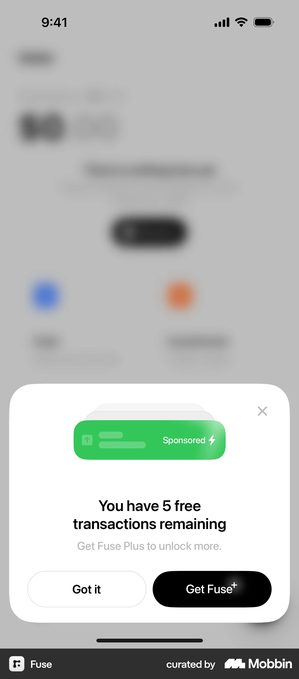
Fuse · charging for the limit before the user hits it
The free tier is metered rather than feature-limited, and Fuse tells you where you are inside it: You have 5 free transactions remaining, on a sheet that appears while you still have five.
That timing is the whole decision. Warn at five and the limit is information, and the user can plan around it or pay. Wait until zero and the identical sentence is a locked door, which is a different product to be sold.
Fixing the price and never fixing the ratio between plans
The number on the button gets all the attention. The relationship between your plans is usually the bigger lever, and three practitioners in Botsi’s Price Power Playbook describe the same win from different angles. Each of these is one person’s self-reported result on one app, so read them as anecdotes with names on them rather than as benchmarks.
- Dan Layfield, who ran subscriptions at Codecademy and now writes Subscription Index, repriced annual to sit a month or two above his average monthly retention. He says he has seen annual go from 5% of the base to 50% on that change alone.
- Daphne Tideman, a growth advisor, had an audit client whose founder was sure they “weren’t a yearly product”. They changed the monthly-to-annual ratio and added one onboarding screen telling people how long they should expect to need the app. Yearly went from 16% of subscriptions to 39%, and paid conversion from 6.6% to 13.7%.
- Michal Parizek moved Mojo’s monthly plan onto a separate screen so annual read as the only option. Annual went from about 60% of plans sold to about 80%, and overall conversion held.
Why the direction is worth chasing at all: annual is where both the money and the retention sit. Phil Carter of Elemental Growth, writing in RevenueCat’s report, puts annual plans at roughly twice the revenue per install of monthly and five times weekly, $0.46, $0.24 and $0.09 median at day 60. Year-one retention runs 20–40% on yearly plans, 6–14% on monthly and 1–2% on weekly.
Centr · the ratio, written out
Centr states both terms plainly, “Annual — $152.99 billed annually” and “Monthly — $29.99 billed monthly” and the ratio is doing the persuading before any badge gets a chance to. Twelve months of the monthly plan is $359.88. The annual price is 5.1 months of it.
That is roughly the shape Layfield describes, if their average monthly subscriber lasts three or four months.
So work out your own number before you copy anybody’s ratio. How many months does your average monthly subscriber actually stay? The same 57% discount is disciplined or reckless depending entirely on that one figure, and it is a figure you already have.
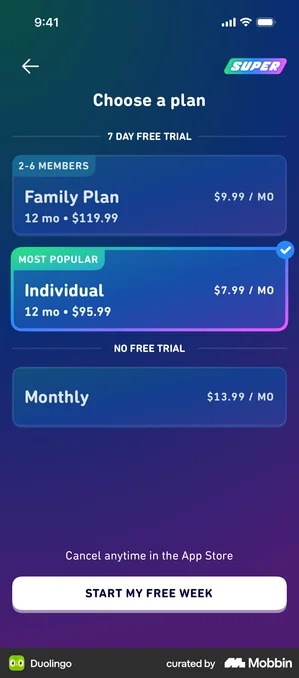
That works because the difference is real: monthly genuinely does not carry the trial. It stops working the moment the band is just a design choice rather than a real difference, at which point you have built a decoy that the user can catch you building.
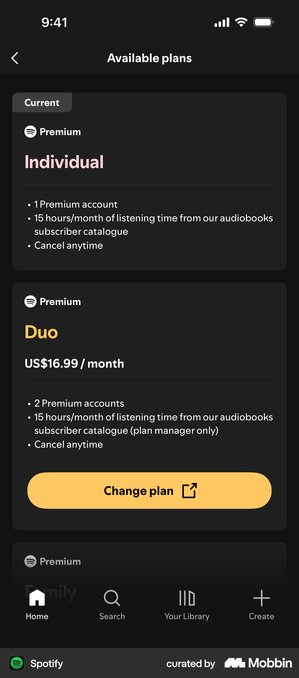
Spotify · a middle plan that is a real product
Spotify stacks Individual, Duo and Family, and the three differ on how many accounts they cover rather than on how often you pay. Duo does the classic middle-option job, it makes Family read as generous and Individual as modest, while still being something two people genuinely buy.
That is the line between framing and a con. A middle plan nobody buys exists only to be rejected, and users work that out faster than founders expect.
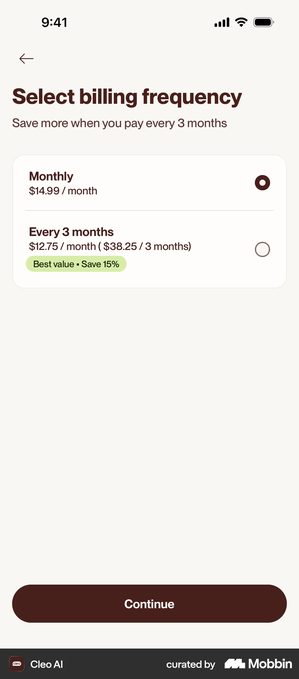
Cleo AI · a third billing period, used as the ratio
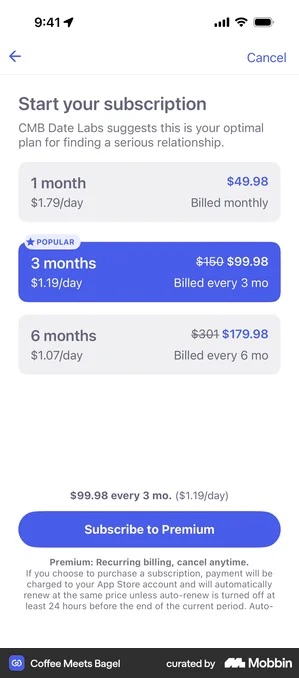
Instead of monthly against annual, the heading reads “Select billing frequency — Save more when you pay every 3 months”, with a “Best value • Save 15%” marker in the plan list. A quarterly term is short enough to feel survivable and long enough to move the payback window.
A quarterly plan earns its place when your monthly one does not hold people for a year, because then twelve months is a commitment neither side can honestly ask for. Watch out, though. If nobody picks it, you have not fixed a ratio. You have added a third decision to a screen that already had one.
The fix
Two plans is the default shape, 41–60% of paywalls across categories show exactly two, Health & Fitness highest at 60%, and only 6–27% show three or more. Pick your two deliberately. Work out your average monthly retention, price annual a month or two above it, and then track the share of subscriptions that go annual rather than the annual price itself.
That share is the number that tells you whether the change worked.
Not testing price points
Most indie creators pick a price and never change it. Pricing is not a one-time decision.
There is a figure that circulates on this point, that apps testing regularly see 15 to 30% revenue variance between their best and worst price points. I cannot source it to anything, so I am not going to repeat it.
What the 2026 data does show is that the tier you sit in tracks with everything downstream of it, and it runs the opposite way to the one most indie founders assume.
What changes when you move price tier
Medians across RevenueCat’s 2026 sample of more than 115,000 apps. Take the three tiers in order, and watch the last line of each one, because it runs the opposite way to the rest.
Priced low
1.4% of downloads pay by day 35
4.4% start a trial
$10.69 year-one value per payer
36% still there a year into an annual plan
Priced in the middle
2.0% of downloads pay by day 35
5.4% start a trial
$28.75 year-one value per payer
Retention not published for this tier
Priced high
2.8% of downloads pay by day 35
8.9% start a trial
$62.19 year-one value per payer
23% still there a year into an annual plan
Three rows point one way and the last row points the other. That is the whole argument of this section, and it is a correlation across a large sample rather than a promise about your app.
Two things worth stealing from people who do this for a living.
Patrick Rills of Lose It! argues for retesting prices you already ruled out. A price that could not beat the control for years can start winning once competitors raise theirs. His own move was $40 to $80 a year, and it gave the team room to discount harder and to compete on acquisition.
And Michal Parizek tested both a 50% and a 100% increase on Mojo’s yearly price in the US. The 100% version made more new revenue outright. They shipped the 50% one, because seven-day cancellations jumped on the expensive version and that projected out to a worse year.
The fix
Treat pricing like any other feature: test, measure, iterate, and judge a price rise on early cancellations rather than on this month’s revenue. Regional tests are where I’d start, mostly because a mistake in a smaller market costs less than a mistake in your biggest one.
Ignoring regional pricing
$9.99 a month is the structural anchor in North America. It is not the anchor everywhere. Median monthly price runs $9.99 in North America against $3.75 in India and Southeast Asia; yearly, $39.99 against $18.32. Across all three durations IN/SEA sits at roughly 46–54% of the top-tier markets (RevenueCat, 2026).
A flat global price is a decision to be about twice the local median across a large part of the world.
Conversion follows the same map. Median day-35 download-to-paid is 2.56% in North America and 1.37% in India and Southeast Asia.
What the report does not measure is what happens to that gap once an app localises its prices. So treat regional pricing as matching a market you can already see, not as a tactic with a published lift attached to it.
The fix
Both Apple and Google make regional pricing easy to set up. Start with three to five high-potential markets; India, Brazil, Indonesia and Mexico are reasonable places to begin. If you want a starting number instead of a guess, roughly half the North American price is where the apps in the dataset already sit in India and Southeast Asia.
Ekaterina Gamsriegler, a B2C growth advisor previously at Mimo, lists “never localised” as one of only four situations in which she thinks cutting a price is the right call, and she means more than the number. Whether the price matches how people in that country expect to pay is part of it.
She also won’t run the test on that signal alone; she wants a bad trial or purchase conversion rate sitting next to it.
What “how people expect to pay” looks like in practice is smaller than it sounds. Glovo’s plan picker in a euro storefront reads:
Get a free trial with any plan · Monthly — First month free, then 6,99 € / month
Comma for the decimal, symbol after the number. It is the same plan everyone else prices at $6.99, written the way that market reads prices, and it is the part of localisation that costs nothing and gets skipped anyway.
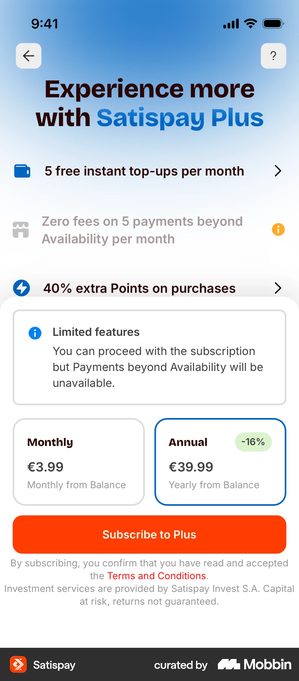
Satispay · localisation is the payment method, not only the number
The subscription is billed from the money already sitting in the user’s Satispay balance, not from a card. The discount shows as a −16% pill, and a notice on the same screen flags which features are limited.
None of which is about the number. It fits because in that market, topping up a balance is the normal way to pay and the card form is the awkward part. Localisation is partly the price and partly this.
Undervaluing your product
Indie creators often think: “I’m just one person, my app is small, I can’t charge much.” Users do not care who built it. Price on what the app replaces, not on your imposter syndrome.
And yes, I am aware that “just charge more” is the most annoying advice in this industry. I would not bring it up if the data went the other way. Look at the next two numbers and then decide whether I am being annoying or right.
The data is on your side on the way in. Higher-priced apps in the 2026 report convert downloads to paid at twice the rate of lower-priced ones (2.8% against 1.4% median) and generate close to six times the year-one value per payer ($62.19 against $10.69).
It reverses further down the funnel, and this is the part nobody quotes. Low-priced apps retain better on annual plans: 36% year-one median against 23% for high-priced, and 37% against 24% at the first annual renewal. By the third renewal the tiers converge. Charging more wins you more payers and loses more of them early. That is a trade worth making on purpose rather than discovering in month four.
The fix
Ask yourself what the alternative costs. If users would otherwise pay $50/month for a service your app replaces, $9.99/month is a bargain. Price on value delivered, not effort invested, and then put the arithmetic on the screen instead of asserting it. Thrive Market does:
Save up to $384 a year! Based on ordering once every two weeks, and average member savings of $32 an order. Savings may vary.
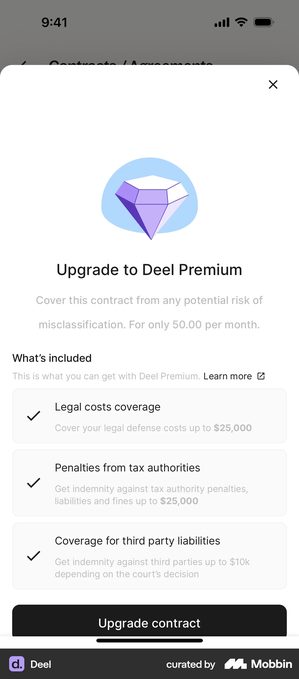
Deel · pricing against what it would cost to be wrong
The upgrade is triggered from a contract screen and framed as risk cover rather than as features, with a specific coverage amount attached to each benefit. There is no trial. The screen’s whole argument is that the subscription costs less than the exposure it removes.
Put the benefit in the customer’s own units and you have the strongest answer there is to “is this worth it”. Not a feature. A number in the currency of the thing they are afraid of.
Now do the arithmetic, because this is the interesting part. Once every two weeks is 26 orders. 26 at $32 is $832, not $384. The $384 would be twelve orders, which is once a month.
So the two halves of that sentence do not agree with each other. The headline is the smaller number, which is the honest direction to be wrong in, but it does mean the working does not actually support the figure it is attached to. Showing your arithmetic only helps if somebody can follow it to the same answer.
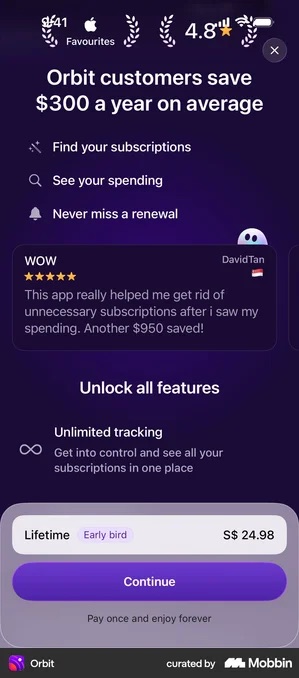
Orbit · leading with the saving, not the price
Orbit opens on “customers save $300 a year on average” and then asks for a one-off lifetime purchase of S$24.98. The order matters: by the time the price appears it reads as arithmetic rather than as a charge.
Which puts all the weight on that $300 being real. An average that quietly hides the fact that most users save nothing does not generate renewals. It generates refund requests, and a review explaining the maths to everybody else.
Not understanding unit economics
Two numbers. What it costs you to get one user, which people write as CAC, and what that user generates over the whole time they stay, written as LTV. At $2 to acquire and $3 back, you lose money at scale once overhead, payment processing and churn are in the picture.
The rule usually quoted next is that LTV should be three to five times CAC. I have not been able to source that ratio to anything, so here is a version you can act on instead. Shumel Lais, co-founder of Day30, draws a straight line from how you are funded to how you package.
Bootstrapped developers push annual hard, not because users want it, but because they cannot afford to wait for renewals to find out whether a group of new subscribers worked. Some want their acquisition cost back inside seven days. Funded apps sit at 60 to 90 days. The biggest apps will wait six to twelve months, which is how they outbid everyone else.
What makes the long wait survivable, in his account, is that most of an LTV curve is set in the first month or two. You don’t need a year of data, you need a buffer and a checkpoint: he watches a group of new subscribers for 45 to 60 days and pulls spend if it is off track.
The fix
Write down the payback window you actually need before you scale, then check whether your plan mix and your paywall default can deliver it. If you need the money back in 60 days and your paywall leads with monthly, change the default rather than the budget.
Subscription fatigue
Users are drowning in subscriptions, and the churn data shows where they act on it. It is not at some later reckoning: it is at the first renewal. Median year-one retention is 20–40% on yearly plans, 6–14% on monthly and 1–2% on weekly.
Alice Muir, the same consultant quoted earlier, reads the same data in RevenueCat’s report. She is credited there under her full name, Alice Muir Kocourková, in case you go looking for it.
Her conclusion: nearly half of monthly subscribers and three in four yearly subscribers never renew even once. Survive that first renewal and retention jumps 18 to 27 percentage points for the second. Survive cycle one and the picture changes completely.
The fix
Make the value visible before that first renewal date, not after it. The deadline is the first charge, not the first quarter, and the charge itself is something you can show rather than hide.
Panera Bread · putting the renewal on the purchase screen
Panera’s subscription screen lists the next four billing dates and amounts, and states that “your card won’t be charged until 9/26”. Nothing about the renewal can ambush anyone, because the renewal schedule was on screen at the moment of purchase.
Right for a habit purchase, where knowing what happens next is the actual pitch. Put those four future charges in front of somebody who is still deciding, though, and you have made the commitment feel four times bigger than it is.
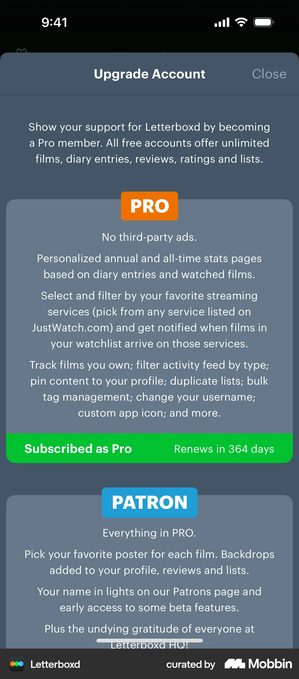
Letterboxd · the renewal date lives inside the plan card
The plan card ends in a green bar: “Subscribed as Pro” on the left, “Renews in 364 days” on the right. So the current state and the next charge are visible wherever plans are shown, rather than filed away in a settings screen the user has to go and find.
Nobody has to hunt for when they will next be charged, and that is the question behind most cancellations made in a hurry. There is very little against it: of everything in the teardown, this is the cheapest trust win.
A one-time option is worth considering too, and it is more common than it looks. About one app in four offers a lifetime plan, and lifetime shows up on 5 to 18% of paywalls depending on the category. Gaming is highest, at 18%.
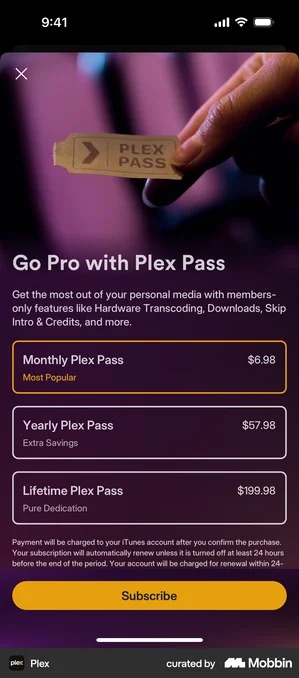
The reason to think before shipping one: lifetime cannibalises subscription revenue you were already collecting from the people most likely to buy it. It wins over the people who dislike recurring billing, and those are not the same people as the ones who find you expensive.
Kit · the tier that appears when it becomes true
Kit splits its plans by audience rather than by billing period, “Single child plan” against “Multi-child plan (2–5 kids)” and shows the pair as a before-and-after at the moment a parent adds a second child. The upgrade is never argued for. It is triggered by the action that makes it necessary.
The same comparison a week earlier is just another decision in the way. Timing is part of packaging.
From our work · Travel Diaries
Travel Diaries sells travel journals online and as printed books. It started free, monetised by book sales, and added a paid membership in 2022. Only about 10% of users converted, and book orders dropped as people wrote online but did not print.
The number itself was not the whole problem. Users were asked to subscribe before seeing any value, and the plans did not map to what different people actually wanted. In the redesign (August to September 2025) we asked a few questions up front about the user’s travel situation and goals, then showed the plan that matched it: online journalling or printing.
Which is the thing this whole article keeps circling. The mistake was rarely the number. It was the packaging around it.
Pricing sanity check
- Price tested with real users, on a sample big enough for your conversion rate
- Free tier delivers the value moment but gates the speed
- Monthly-to-annual ratio set deliberately, not inherited
- Regional pricing set for your top 3–5 markets
- Payback window written down, and your plan mix can deliver it
- Price reflects value to the user, not cost of development
- Value is visible before the first renewal, not after it
Got questions? I’ve got answers
How do I choose a price for my app?
Test rather than guess, but size the test against your own conversion rate. Across 115,000+ apps, the median freemium app converts 2.1% of its installs to paid by day 35, so a few hundred users give you a handful of buyers per version tested and no readable answer. Your development time is not a pricing input, and a competitor’s price only transfers when audience, features and positioning genuinely match.
How generous should my free tier be?
Generous enough that people reach the value moment, limited enough that they hit a wall. RevenueCat’s State of Subscription Apps 2026 puts median day-35 download-to-paid at 2.1% for freemium apps against 10.7% for apps with a hard paywall, with almost identical year-one retention. Subscription consultant Alice Muir suggests gating speed rather than capability: find the free feature that only saves people time, and charge for that.
How often should I change my price?
Treat pricing as an ongoing experiment, and go back and retest prices you already ruled out. A price that could not beat the control for years can start winning once your competitors raise theirs.
And judge an increase on seven-day cancellations rather than on this month’s revenue. Michal Parizek shipped a 50% rise at Mojo instead of the 100% one that made more new revenue, because cancellations spiked on the expensive version.
Should my app offer a lifetime plan?
About one app in four offers one, and a lifetime option appears on 5-18% of paywalls depending on category, highest in Gaming at 18% (RevenueCat, 2026). It converts the segment that dislikes recurring billing, which is not the same segment as the one that finds you expensive. The cost is that it cannibalises subscription revenue you were already collecting from your most committed users.